
 25-09-2026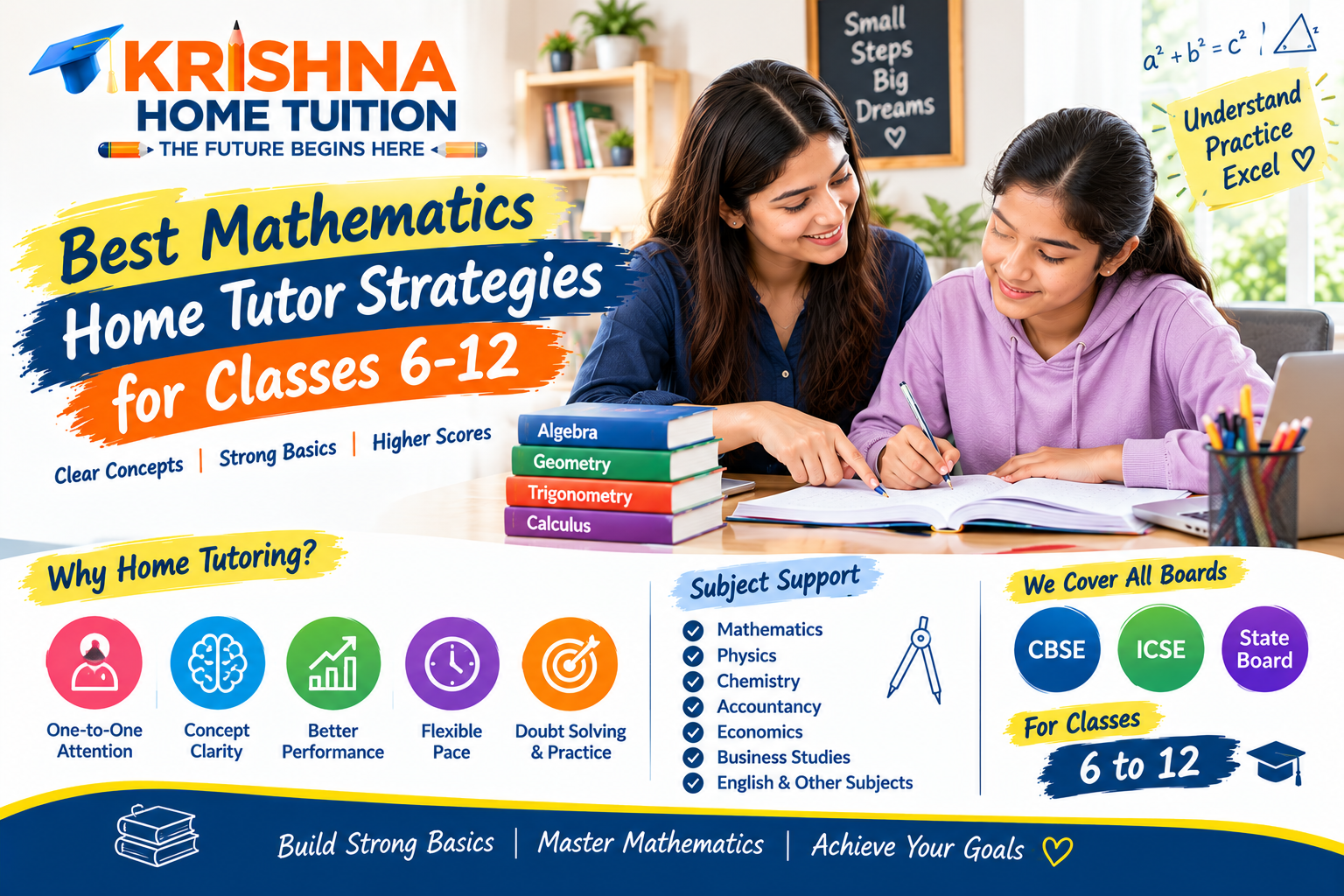
Mathematics can feel like a mountain for many students between Classes 6 and 12. One missed concept in Class 7 can turn into confusion by Class 10, and that confusion often snowballs into exam anxiety. This is exactly where a good Home Tutor makes all the difference. A skilled tutor does not just explain formulas. They identify gaps, build a student's confidence, and turn a subject full of dread into one of curiosity. If you are a parent searching for the right guidance for your child, understanding what makes a math home tutor effective can help you make a smarter choice.
Classroom teaching follows a fixed pace. Not every student can keep up, and not every student needs to slow down either. A home tutor removes this mismatch completely.
When a tutor works with just one student, they can spot exactly where the confusion starts. Maybe it's fractions, maybe it's trigonometry ratios, or maybe it's simply exam fear. This kind of attention is nearly impossible in a classroom of thirty students.
Some chapters need more time than others. A home tutor can slow down on algebra if needed and move faster through topics the student already understands well. This flexibility keeps learning stress-free and steady.
Before jumping into advanced problems, effective tutors always revisit the fundamentals. Number systems, basic operations, and simple equations form the foundation for everything that comes later, including calculus in Class 12. Skipping this step often causes trouble down the line.
Many students try to memorize formulas without understanding why they work. A good tutor flips this approach. They explain the logic behind a formula first, so the student can apply it to different types of questions, not just the ones they have memorized answers for.
Solving fifty random questions is not the same as solving ten well-chosen ones. Experienced tutors pick problems that target specific weak areas. This saves time and builds real problem-solving skill instead of just repetition.
Doubts pile up quickly in math. A single unresolved doubt in geometry can block progress in the next three chapters. Tutors who dedicate time specifically for doubt-clearing help students stay on track instead of falling behind silently.
At this stage, the focus should be on making math fun and logical rather than scary. Visual aids, real-life examples, and simple step-by-step problem solving work best. Tutors often use everyday situations, like calculating discounts while shopping, to make abstract ideas relatable.
Board exams bring pressure, and this is where structured practice matters most. Tutors usually introduce timed tests, previous year question papers, and chapter-wise revision plans. Consistency becomes more important than speed at this stage. For students following the CBSE board specifically, it helps to look into some proven approaches for CBSE Class 10 exam preparation, since board-specific strategies can make revision far more targeted and effective.
Higher-level math involves calculus, vectors, and probability, subjects that demand deeper reasoning. Good tutors connect these topics to competitive exam patterns as well, since many students in this age group are also preparing for entrance tests alongside board exams.
Many families searching for reliable guidance eventually turn to a trusted home tuition service in Panchkula that connects students with experienced mathematics tutors suited to their exact class and learning pace. Choosing a service that understands both the syllabus and the student's individual needs often makes the transition between class levels much smoother.
Tutoring works best when parents stay involved without micromanaging. A quick weekly check-in with the tutor about progress, without pressuring the child constantly, keeps everyone aligned. Parents should also ensure a quiet, distraction-free space during tutoring sessions, since even small interruptions can break a student's focus during problem-solving.
Location matters when choosing a home tutor because local tutors understand the specific school boards and syllabus patterns common in that area. Families looking for a Best Home Tutor in Panchkula often prioritize tutors who are familiar with CBSE and ICSE patterns followed in nearby schools. Similarly, a Home Tutor in Mohali or a Home Tutor in Chandigarh should ideally have experience with the academic pace and exam expectations typical to that region.
Parents searching for a Home Tutor in Panchkula or a Home Tutor in Zirakpur should also consider convenience. A tutor who lives nearby can offer flexible scheduling and quicker doubt-resolution outside regular class hours, which adds real value over time.
A good tutor does more than complete the syllabus. Watch for these signs:
If these signs are missing after a few months, it may be worth reconsidering the tutoring approach.
Mathematics does not have to be a subject students dread. With the right home tutor, personalized attention, and consistent practice, any student from Class 6 to Class 12 can build both skill and confidence. Whether you are exploring options in Panchkula, Mohali, Chandigarh, or Zirakpur, focus on finding a tutor who prioritizes understanding over shortcuts. That single choice can shape a student's relationship with mathematics for years to come.
1. How often should a student have math tutoring sessions?
Most students benefit from two to three sessions per week, though this can vary based on how comfortable the student is with the subject.
2. At what class level should home tutoring start for math?
Class 6 is a good starting point since it introduces concepts that form the base for higher-level math later on.
3. Can a home tutor help with competitive exam preparation too?
Yes, many tutors for Classes 11 and 12 also incorporate competitive exam patterns alongside regular board exam preparation.
4. What should parents look for in a math home tutor?
Look for patience, strong subject knowledge, a structured teaching approach, and the ability to explain concepts in simple terms.
5. How long does it take to see improvement with a home tutor?
Noticeable improvement usually takes about six to eight weeks of consistent, focused sessions.