
 06-11-2026
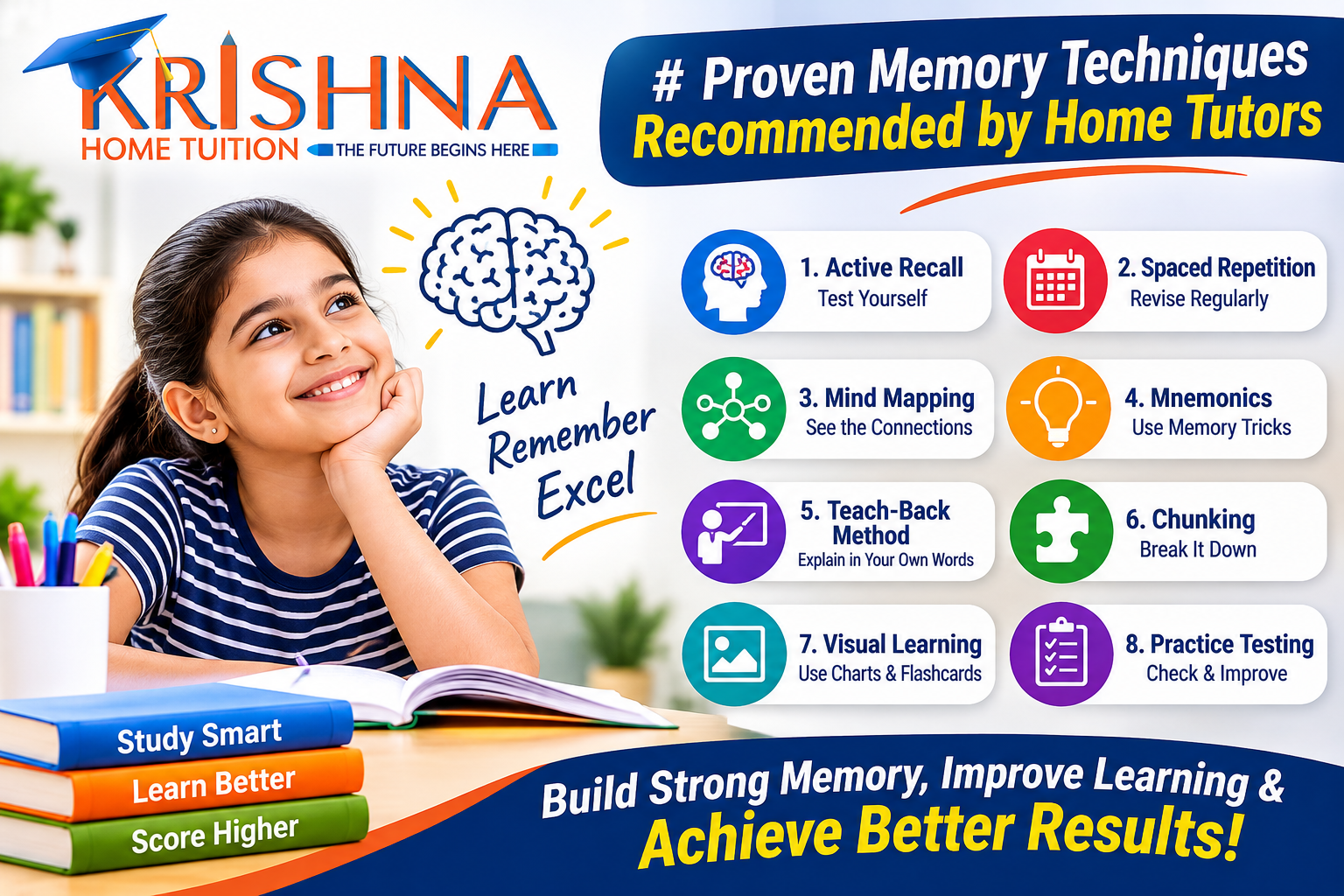
Every student wants to remember what they study, especially during school tests and board examinations. However, reading the same chapter several times does not always lead to better memory. Students need the right learning strategies to understand information, remember important concepts, and recall them when required. This is where a Chandigarh Home Tutor can make a real difference.
Experienced home tutors understand that every student learns differently. Some students remember information through visual examples, while others learn better through writing, discussions, or practical activities. By using proven memory techniques, tutors help students improve concentration, develop stronger learning habits, and retain information for longer.
Parents looking for quality home education often consider personalized teaching because it allows tutors to identify learning difficulties and introduce suitable memory-building strategies.
Forgetting is a normal part of the learning process. However, certain study habits can make it more difficult for students to remember information.
Some common reasons include:
A good tutor identifies these problems before recommending a suitable learning approach.
Home tutors use different learning methods to help students remember information more effectively. Here are eight practical techniques that students can include in their daily study routines.
Active recall is one of the most effective memory techniques. Instead of reading a topic repeatedly, students try to remember information without looking at their books.
For example, after completing a science chapter, students can close their textbooks and answer questions about the main concepts. They can also write down everything they remember about a particular topic.
A home tutor can make this activity more interesting through short quizzes, oral questions, and practice worksheets.
This method encourages the brain to retrieve stored information. Regular practice can make recalling important concepts easier during examinations.
Studying everything in one sitting is not always effective. Students may remember information for a short period but forget it after a few days.
Spaced repetition solves this problem by spreading revision sessions over time.
A simple revision schedule can look like this:
Tutors can adjust this schedule according to the student's progress and subject difficulty.
This approach helps students revisit important information before they completely forget it.
Mind mapping is a visual learning technique that connects related ideas around a central topic.
For example, while studying the human digestive system, students can write the main topic in the centre and create branches for the mouth, stomach, small intestine, and large intestine.
Each branch can contain important functions and short explanations.
This method is especially helpful for students who find long textbook paragraphs difficult to remember.
A Best Home Tuition in Chandigarh learning approach should encourage students to understand connections between concepts instead of memorizing every line.
Mnemonics help students remember information through simple words, phrases, patterns, or associations.
For example, students can use short phrases to remember the order of planets, scientific classifications, or mathematical formulas.
Tutors can also create simple memory stories using difficult terms.
These techniques are useful when students need to remember lists, definitions, formulas, and important sequences.
However, mnemonics should support understanding rather than replace it.
One of the best ways to check whether a student understands a topic is to ask them to explain it in their own words.
This is known as the teach-back method.
After teaching a lesson, tutors can ask students to explain the same concept as if they were teaching a younger student.
For example, after completing a mathematics chapter, a tutor may ask the student to explain the steps involved in solving a particular problem.
If the student struggles to explain the concept, the tutor can identify the learning gap and provide further clarification.
This method improves understanding, confidence, and the ability to recall information.
Large chapters and lengthy information can feel overwhelming. Chunking makes learning easier by dividing information into smaller, meaningful sections.
For example, instead of learning an entire history chapter at once, students can divide it into:
Students can then study each section separately before connecting everything.
This method is useful for learning long answers, scientific processes, mathematical steps, and difficult definitions.
Visual learning can make difficult concepts easier to understand and remember.
Tutors often use diagrams, flowcharts, flashcards, and colourful notes to explain important topics.
Flashcards are particularly helpful for quick revision. One side can contain a question or keyword, while the other side contains its answer.
For example, a student learning English vocabulary can write a new word on one side and its meaning with an example sentence on the other.
Similarly, science students can use labelled diagrams to remember different parts of the human body.
Testing is not only useful for checking preparation. It also helps students identify what they have remembered and which topics need additional attention.
Home tutors can conduct short tests after completing individual chapters.
These tests may include:
Students should review their mistakes and understand why an answer was incorrect.
Regular self-assessment also helps students become more comfortable with examination patterns.
Memory improvement requires consistency, guidance, and the right learning environment. A professional tutor does more than explain textbook chapters. They observe how students learn and identify methods that make information easier to understand.
Here are some ways tutors support better memory development.
Every student has different learning requirements. Some need additional explanations, while others benefit from visual examples or repeated practice.
A tutor can adjust the teaching approach according to the student's understanding and progress.
In a one-to-one learning environment, students can ask questions without hesitation. Tutors can immediately address doubts and explain difficult concepts using simpler examples.
A proper revision timetable prevents students from leaving everything until the last moment.
Tutors can divide the syllabus into manageable sections and schedule regular revision sessions.
Students often forget information when they feel nervous about examinations. Regular practice, mock tests, and positive feedback can help them become more confident.
Choosing a suitable tutor is an important decision for parents. The right teacher should understand the student's academic requirements and provide consistent learning support.
When searching for Home Tuition in Chandigarh, parents should consider the following factors:
Parents searching for a Best Home Tutor in Chandigarh should also consider whether the teacher focuses on conceptual understanding rather than encouraging students to memorize answers without understanding them.
For families exploring personalized academic support, Krishna Home Tuition offers home tuition options for students across different classes and subjects. Parents interested in learning more about available teaching arrangements can also visit the home tuition admission page.
Memory techniques work best when students combine them with healthy and consistent daily habits.
Here are some simple habits that can support better learning:
Parents should encourage children to follow these habits without creating unnecessary academic pressure.
Strong memory skills develop through regular practice and effective learning strategies. Techniques such as active recall, spaced repetition, mind mapping, chunking, and practice testing can help students understand and remember information more effectively.
A supportive tutor can make these techniques part of a student's everyday learning routine. With personalized guidance, regular revision, and consistent encouragement, students can develop better study habits and approach examinations with greater confidence.
The goal of effective home tuition is not simply to help students complete their syllabus. It is to teach them how to learn, understand, remember, and apply knowledge independently.
Active recall, spaced repetition, mind mapping, mnemonics, and flashcards are some useful memory techniques. Students should choose methods that suit their learning requirements.
A home tutor can introduce personalized revision schedules, regular quizzes, visual learning activities, and practice tests. These methods help students improve understanding and information retention.
Students should revise important topics on the same day and revisit them after one day, three days, and one week. The schedule can be adjusted according to the subject and learning progress.
Active recall encourages students to retrieve information from memory instead of simply recognizing familiar text. It is generally a more effective revision strategy than passive rereading alone.
Yes. Memory techniques can help students organize information, revise important concepts, remember formulas, and practise answering questions. Regular written practice is also important.
Parents can provide a quiet study environment, encourage regular revision, reduce distractions, maintain a consistent routine, and appreciate their child's learning efforts.
Parents can explore Krishna Home Tuition for personalized home tuition support across different classes and subjects in Chandigarh. They can enquire about suitable teaching arrangements based on their child's academic requirements.